
Economists highlight that resolving domestic policy bottlenecks, particularly through land reforms and improving the ease of doing business, will be critical for Prime Minister Narendra Modi's 'next-generation reforms' and India's economic transformation towards its 'Viksit Bharat' vision for 2047.

'The day we start making rules purely along caste lines, we only divide society further. That's the conversation the government needs to have, and soon.'

Delhi Police detained several anti-reservation protesters at Jantar Mantar who were demanding that economic criteria be prioritised over caste for government support and reservation. The protest, mobilised via social media by 'Reservation Hatao Andolan', proceeded despite police denying permission for Jantar Mantar and offering Ramlila Ground as an alternative venue. Demonstrators called for a review of the existing reservation system and the introduction of a creamy-layer criterion.

'Wages have not risen. Rural wages have stagnated. The growth was 0.7 per cent last year. For casual and irregular labour, the wage growth is negative.'

'It is not because of the war in West Asia, which began on February 28.' 'Petroleum product prices are already going through the roof. They are bound to have a serious inflationary impact.' 'A country's leadership is tested in trying times. It is here that the current leadership is failing.'

'My suggestion to Nandan Nilekani is that it would be worthwhile for him to take a holistic review in a manner in which examination is just one critical component.'

'Improved law and order and transparent governance have helped change UP's investment image.'

'You have to get private investment to somewhere between 35% to 36% of GDP. It is hovering about 30%-31%.'

Ashok Lahiri, a distinguished economist with experience in government, the private sector, and electoral politics, has been appointed as the new Vice-Chairman of NITI Aayog, tasked with strengthening India's reform trajectory and policy-making.

India's government is working to resolve tax and regulatory hurdles to bring Formula One back to the Buddh International Circuit on the outskirts of New Delhi in 2028, more than a decade after the race was dropped.
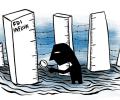
India's foreign direct investment (FDI) inflows are projected to surpass $90 billion in 2025-26 (FY26), driven by robust policy reforms, free trade agreements, and strong economic growth, according to DPIIT Secretary Amardeep Singh Bhatia.

The challenge thrown by the youth movement creates the opportunity for a more consequential debate on India's economic trajectory because it must remain centered on India's youth as its driving impulse, asserts former foreign secretary Shyam Saran.

A research paper by the National Council of Applied Economic Research (NCAER) recommends that Bihar revoke its alcohol ban, citing its failure to reduce violence against women and a rise in illicit drug and alcohol consumption. The report suggests that reinstating the liquor excise tax would significantly increase state revenues and decrease enforcement costs.

Brokerage Bernstein has warned Prime Minister Narendra Modi that India risks squandering recent economic gains unless it accelerates structural reforms, particularly in jobs, manufacturing and innovation.

'The prohibition regime has been accompanied by concerns regarding the expansion of the illicit liquor trade, increased enforcement challenges and corruption, and the growing use of alternative intoxicants, including illicit drugs.'

'Every period of excessive optimism eventually gives way to a correction, while periods of extreme pessimism often create the best investment opportunities.'
'Policy consistency combined with timely and calibrated reforms are expected to ensure that India not only maintains macroeconomic stability, but also emerges as a globally competitive and inclusive economy.'

Underlining that students are the "architects of India's future," President Droupadi Murmu on Friday said the government is taking comprehensive steps to reform public examinations to completely curb paper leaks and unfair means, making the system transparent, secure, and trustworthy.

'We can integrate AI and tech into education, but that is just a means and not an end.' 'Ultimately, we need to control what happens in a classroom and we need to let teachers innovate their teaching style to suit the needs of Gen Z and beyond.'

Despite aggressive expansion, India's solar power sector faces significant hurdles from rising regional disparities in installed capacity and a looming manufacturing glut due to overcapacity in domestic solar equipment production, potentially leading to consolidation and pricing pressures.

US Federal Reserve Chairman Kevin Warsh has picked former RBI governor Raghuram Rajan, Harvard University economics Professor Raj Chetty and Microsoft XBOX CEO Asha Sharma to be part of task forces constituted to examine the central bank's approach to monetary policy and propose transformational changes.

As India's decline continued on global indices, the government first blamed methodology and then motives. This is where we remain today as we wish each other and ourselves a happy Independence Day, points out Aakar Patel.

'We believe the truth is in the middle, and that India is at an important crossroads.'

In her address to the nation on the eve of the country's 80th Independence Day, the president stressed that just as government and society remain united to ensure national security, everyone must contribute through joint and concerted efforts to safeguard the present and future of students.

The Economic Survey on Thursday projected the GDP growth in the range of 6.8 to 7.2 per cent in 2026-27, a tad lower than 7.4 per cent estimated in the current fiscal.

'We have to pull 80 million workers out of agriculture and go back to where we were in 2014. That itself is going to be a huge task.' 'We have already lost time, and that is a catastrophe impending.''

India too can rise to the top if the 1.4 billion Indians back home are given better opportunities to use their innate talent and capacity to work hard, with right incentives in a more meritocratic rules-based system, asserts Ajay Chhibber.

That means making it easier to invest, protecting investors through predictable rules, and avoiding policy reversals after investments have been made, notes Rajeswari Sengupta.

'Why not aspire for 8 or 9 or even 10 per cent?'

Veteran banker K V Kamath stresses the importance of reskilling and education reforms to leverage artificial intelligence (AI) in India, advocating for practical applications over expensive foundational models.

The Congress escalated its campaign against alleged examination irregularities by marching to Prime Minister Narendra Modi's residence, transforming the issue into a direct challenge to his political authority and demanding the resignations of top government officials.

India's finance ministry anticipates inflation will remain relatively contained in the coming months, supported by a correction in crude oil prices and softening input costs following the cessation of the West Asia conflict, despite earlier spikes in wholesale and retail inflation.

Notwithstanding the economic complementarities and the host of agreements for deepening economic relation on a host of areas, both sides share common viewpoints on the foreign policy domain and seek common grounds to serve as a counterweight to China, notes Dr Rajaram Panda.

Benchmark lending rates unchanged with repo rate at 5.25%

'Our leaders, including Mallikarjun Kharge and Rahul Gandhi, are in touch with all Opposition parties, including the DMK and the AAP.'

State Bank of India Chairman C S Setty has expressed support for a 'pause' in policy rates by the Reserve Bank of India's monetary policy committee, believing it will help stabilise conditions and support economic growth. He also urged investors to look beyond short-term equity market movements and focus on India's structural transformation, driven by reforms and digital infrastructure.

History may remember Takaichi Sanae not as the leader who simply accelerated Japanese rearmament, but as one who governed during Japan's transition from an industrial-age security model to a post-industrial strategic member of the global order, points out Varun Arya.

Chief Economic Advisor V Anantha Nageswaran stated that India's economy is projected to return to a 7 per cent-plus growth trajectory by 2027-28 (FY28), or sooner if external conditions improve, despite near-term challenges from the West Asia crisis.

Despite decades of efforts towards energy transition, oil will remain the critical energy source for all nations for some decades. We can hope for peace opening the Strait of Hormuz, but must prepare for war closing it, points out former foreign secretary Ranjan Mathai.

Through policy interventions, Indian cities need to be reimagined as a network of inter-connected assets and services which serve to strengthen the social contract between citizens and their cities by improving their quality of life, the Economic Survey has flagged.
